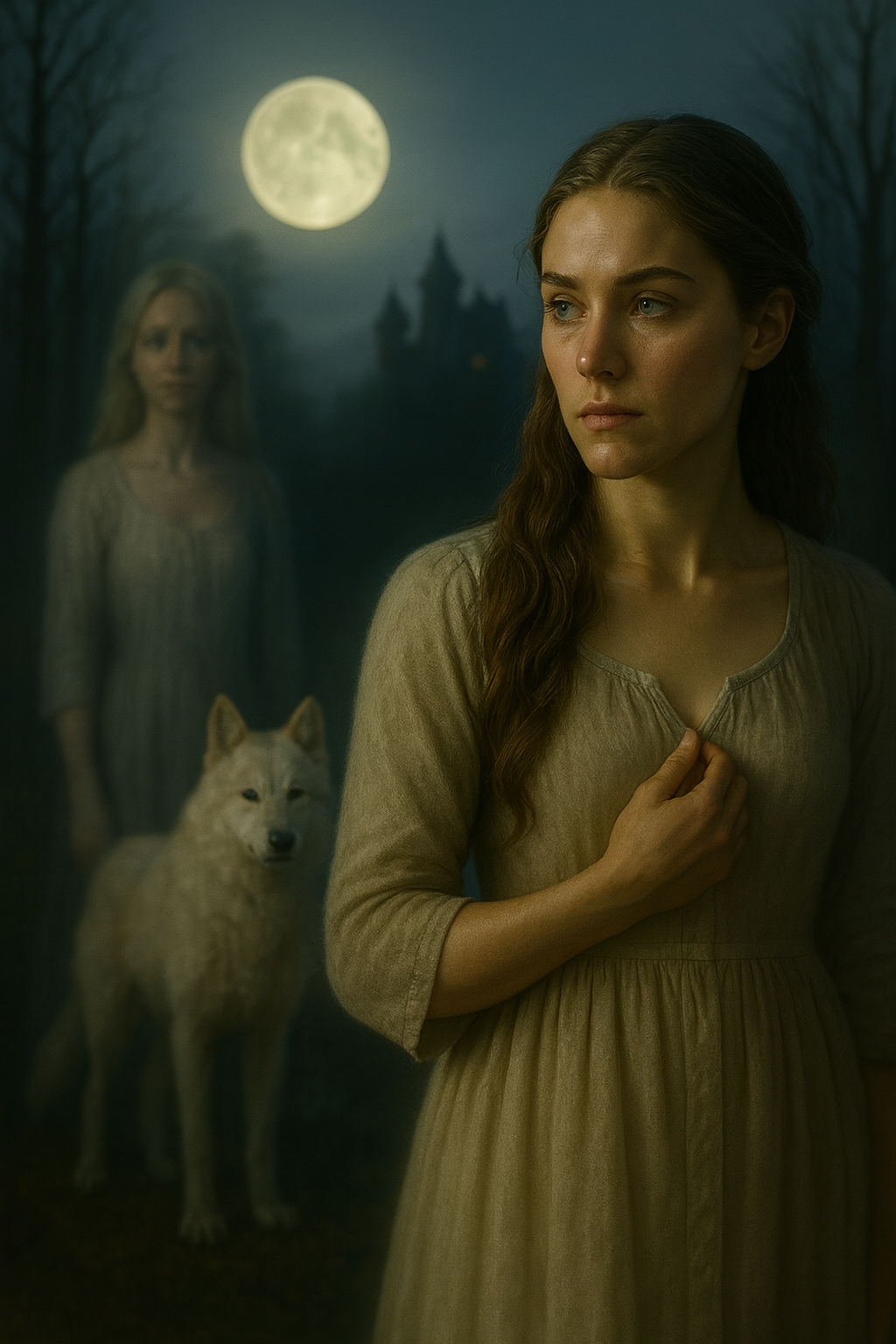

About this Poem
First published in 1816, "Christabel" was Coleridge's great unfinished work — a gothic ballad he laboured over for nearly two decades yet never completed. That very incompleteness has become central to its mystique, inviting every reader to finish it in their own imagination. The screenplay by CM Dinsmore offers one carefully conceived conclusion.
Part the First
❧
'Tis the middle of night by the castle clock,
And the owls have awakened the crowing cock;
Tu—whit! Tu—whoo!
And hark, again! the crowing cock,
How drowsily it crew.
Sir Leoline, the Baron rich,
Hath a toothless mastiff bitch;
From her kennel beneath the rock
She maketh answer to the clock,
Four for the quarters, and twelve for the hour;
Ever and aye, by shine and shower,
Sixteen short howls, not over loud;
Some say, she sees my lady's shroud.
Is the night chilly and dark?
The night is chilly, but not dark.
The thin gray cloud is spread on high,
It covers but not hides the sky.
The moon is behind, and at the full;
And yet she looks both small and dull.
The night is chill, the cloud is gray:
'Tis a month before the month of May,
And the Spring comes slowly up this way.
The lovely lady, Christabel,
Whom her father loves so well,
What makes her in the wood so late,
A furlong from the castle gate?
She had dreams all yesternight
Of her own betrothèd knight;
And she in the midnight wood will pray
For the weal of her lover that's far away.
She stole along, she nothing spoke,
The sighs she heaved were soft and low,
And naught was green upon the oak
But moss and rarest misletoe:
She kneels beneath the huge oak tree,
And in silence prayeth she.
The lady sprang up suddenly,
The lovely lady, Christabel!
It moaned as near, as near can be,
But what it is she cannot tell.—
On the other side it seems to be,
Of the huge, broad-breasted, old oak tree.
The night is chill; the forest bare;
Is it the wind that moaneth bleak?
There is not wind enough in the air
To move away the ringlet curl
From the lovely lady's cheek—
There is not wind enough to twirl
The one red leaf, the last of its clan,
That dances as often as dance it can,
Hanging so light, and hanging so high,
On the topmost twig that looks up at the sky.
Hush, beating heart of Christabel!
Jesu, Maria, shield her well!
She folded her arms beneath her cloak,
And stole to the other side of the oak.
What sees she there?
There she sees a damsel bright,
Drest in a silken robe of white,
That shadowy in the moonlight shone:
The neck that made that white robe wan,
Her stately neck, and arms were bare;
Her blue-veined feet unsandl'd were,
And wildly glittered here and there
The gems entangled in her hair.
I guess, 'twas frightful there to see
A lady so richly clad as she—
Beautiful exceedingly!
Mary mother, save me now!
(Said Christabel) And who art thou?
The lady strange made answer meet,
And her voice was faint and sweet:—
Have pity on my sore distress,
I scarce can speak for weariness:
Stretch forth thy hand, and have no fear!
Said Christabel, How camest thou here?
My sire is of a noble line,
And my name is Geraldine:
Five warriors seized me yestermorn,
Me, even me, a maid forlorn:
They choked my cries with force and fright,
And tied me on a palfrey white.
The palfrey was as fleet as wind,
And they rode furiously behind.
He placed me underneath this oak;
He swore they would return with haste;
Whither they went I cannot tell—
Stretch forth thy hand (thus ended she),
And help a wretched maid to flee.
Then Christabel stretched forth her hand,
And comforted fair Geraldine:
O well, bright dame! may you command
The service of Sir Leoline;
And gladly our stout chivalry
Will he send forth and friends withal
To guide and guard you safe and free
Home to your noble father's hall.
They crossed the moat, and Christabel
Took the key that fitted well;
The lady sank, belike through pain,
And Christabel with might and main
Lifted her up, a weary weight,
Over the threshold of the gate:
Then the lady rose again,
And moved, as she were not in pain.
So free from danger, free from fear,
They crossed the court: right glad they were.
Outside her kennel, the mastiff old
Lay fast asleep, in moonshine cold.
The mastiff old did not awake,
Yet she an angry moan did make!
Never till now she uttered yell
Beneath the eye of Christabel.
They passed the hall, that echoes still,
Pass as lightly as you will!
But when the lady passed, there came
A tongue of light, a fit of flame;
And Christabel saw the lady's eye,
O softly tread, said Christabel,
My father seldom sleepeth well.
Sweet Christabel her feet doth bare,
And jealous of the listening air
They steal their way from stair to stair,
Now in glimmer, and now in gloom,
And now they pass the Baron's room,
As still as death, with stifled breath!
The silver lamp burns dead and dim;
But Christabel the lamp will trim.
She trimmed the lamp, and made it bright,
And left it swinging to and fro,
While Geraldine, in wretched plight,
Sank down upon the floor below.
O weary lady, Geraldine,
I pray you, drink this cordial wine!
It is a wine of virtuous powers;
My mother made it of wild flowers.
Christabel answered—Woe is me!
She died the hour that I was born.
O mother dear! that thou wert here!
I would, said Geraldine, she were!
But soon with altered voice, said she—
'Off, wandering mother! Peak and pine!
I have power to bid thee flee.'
And why with hollow voice cries she,
'Off, woman, off! this hour is mine—
Off, woman, off! 'tis given to me.'
And thus the lofty lady spake—
'In the touch of this bosom there worketh a spell,
Which is lord of thy utterance, Christabel!
Thou knowest to-night, and wilt know to-morrow,
This mark of my shame, this seal of my sorrow;
That in the dim forest
Thou heard'st a low moaning,
And found'st a bright lady, surpassingly fair;
And didst bring her home with thee in love and in charity,
To shield her and shelter her from the damp air.'
It was a lovely sight to see
The lady Christabel, when she
Was praying at the old oak tree.
Her face resigned to bliss or bale—
Her face, oh call it fair not pale,
With open eyes (ah woe is me!)
Asleep, and dreaming fearfully,
O sorrow and shame! Can this be she,
The lady, who knelt at the old oak tree?
And lo! the worker of these harms,
That holds the maiden in her arms,
Seems to slumber still and mild,
As a mother with her child.
O Geraldine! one hour was thine—
But now they are jubilant anew,
Tu—whoo! tu—whoo! from wood and fell!
And see! the lady Christabel
Gathers herself from out her trance;
Her limbs relax, her countenance
Grows sad and soft; the smooth thin lids
Close o'er her eyes; and tears she sheds—
Large tears that leave the lashes bright!
Yea, she doth smile, and she doth weep,
Like a youthful hermitess,
Beauteous in a wilderness,
Who, praying always, prays in sleep.
But this she knows, in joys and woes,
That saints will aid if men will call:
For the blue sky bends over all!
Part the Second
❧
Each matin bell, the Baron saith,
Knells us back to a world of death.
These words Sir Leoline first said,
When he rose and found his lady dead:
And hence the custom and law began
That still at dawn the sacristan,
Who duly pulls the heavy bell,
Five and forty beads must tell
Between each stroke—a warning knell,
Which not a soul can choose but hear
From Bratha Head to Wyndermere.
The air is still! through mist and cloud
That merry peal comes ringing loud;
And Geraldine shakes off her dread,
And rises lightly from the bed;
Puts on her silken vestments white,
And tricks her hair in lovely plight,
And nothing doubting of her spell
Awakens the lady Christabel.
'Sleep you, sweet lady Christabel?
I trust that you have rested well.'
'Sure I have sinn'd!' said Christabel,
'Now heaven be praised if all be well!'
And in low faltering tones, yet sweet,
Did she the lofty lady greet
With such perplexity of mind
As dreams too lively leave behind.
The lovely maid and the lady tall
Are pacing both into the hall,
And pacing on through page and groom,
Enter the Baron's presence-room.
The Baron rose, and while he prest
His gentle daughter to his breast,
The lady Geraldine espies,
And gave such welcome to the same,
As might beseem so bright a dame!
But when he heard the lady's tale,
Why waxed Sir Leoline so pale,
Murmuring o'er the name again,
Lord Roland de Vaux of Tryermaine?
Alas! they had been friends in youth;
But whispering tongues can poison truth;
And to be wroth with one we love
Doth work like madness in the brain.
Each spake words of high disdain
And insult to his heart's best brother:
They parted—ne'er to meet again!
They stood aloof, the scars remaining,
Like cliffs which had been rent asunder;
A dreary sea now flows between.
Sir Leoline, a moment's space,
Stood gazing on the damsel's face;
And the youthful Lord of Tryermaine
Came back upon his heart again.
O then the Baron forgot his age,
His bitter griefs, withering and rage;
He made the child a solemn vow
To love and shield her with his power,
And bless'd her in his castle tower.
[The narrative breaks — Bracy's dream of the dove and the snake; Christabel's trance and Geraldine's baleful look.]
A snake's small eye blinks dull and shy,
And the lady's eyes they shrunk in her head,
Each shrunk up to a serpent's eye,
And with somewhat of malice, and more of dread
At Christabel she looked askance!—
One moment—and the sight was fled!
But Christabel in dizzy trance,
Stumbling on the unsteady ground—
Shuddered aloud, with a hissing sound;
Why is thy cheek so wan and wild,
Sir Leoline? Thy only child
Lies at thy feet, thy joy, thy pride,
So fair, so innocent, so mild;
The same, for whom thy lady died!
O by the pangs of her dear mother
Think thou no evil of thy child!
Sir Leoline!
And wouldst thou wrong thy only child,
Her child and thine?
Within the Baron's heart and brain
If thoughts, like these, had any share,
They only swelled his rage and pain,
His heart was cleft with pain and rage,
His cheeks they quivered, his eyes were wild,
Dishonoured thus in his old age;
He rolled his eye with stern regard
Upon the gentle minstrel bard,
And said in tones abrupt, austere—
'Why, Bracy! dost thou loiter here?
I bade thee hence!' The bard obeyed;
And turning from his own sweet maid,
The agèd knight, Sir Leoline,
Led forth the lady Geraldine!
A little child, a limber elf,
Singing, dancing to itself,
A fairy thing with red round cheeks,
That always finds, and never seeks,
Makes such a vision to the sight
As fills a father's eyes with light.
Perhaps 'tis pretty to force together
Thoughts so all unlike each other;
To mutter and mock a broken charm,
To dally with wrong that does no harm.
And what, if in a world of sin
(O sorrow and shame should this be true!)
Such giddiness of heart and brain
Comes seldom save from rage and pain,
So talks as it's most used to do.
Part the Third
❧
Never Written by Coleridge
· · ·
Coleridge never completed the third part, describing himself as "distracted by too many possible endings." The poem rests here, suspended between revelation and mystery.
The screenplay by CM Dinsmore offers one carefully considered conclusion.